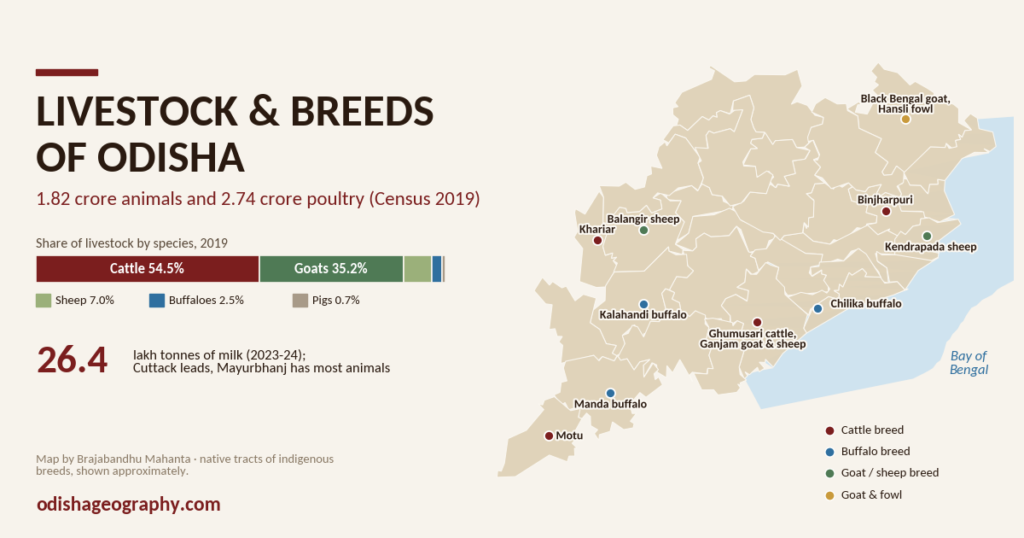

Dairy development means the planned improvement of milk production, collection, processing and marketing, so that farmers earn more from their animals and consumers get more and safer milk. In India it is closely associated with the cooperative movement pioneered at Anand in Gujarat and spread across the country through Operation Flood, the programme that made India the world’s largest milk producer.
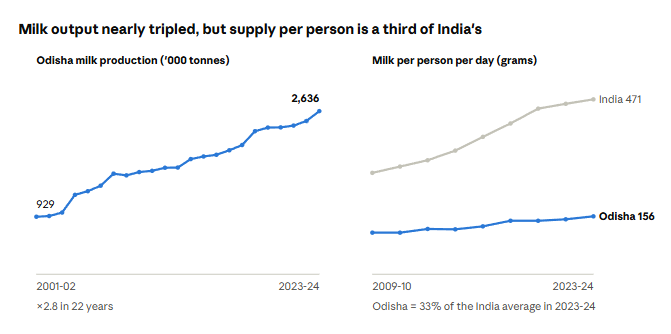
Odisha came late to this movement and still lags behind most states. In 2023-24 the state produced about 26.4 lakh tonnes of milk, ranking 16th in India, and its per capita availability of about 156 grams per day was only about a third of the national average of 471 grams per day. Yet dairying is growing fast. Milk production has nearly tripled since 2001-02, the state cooperative federation OMFED now procures more than 7 lakh litres of milk a day from over 3 lakh farmers through more than 4,600 village dairy cooperatives, and the government is investing in new dairy plants, chilling centres and cooperative societies.
For a state where most farmers are small or marginal, and many are landless, dairying offers something crops cannot: a daily cash income that continues through droughts and between harvests, largely managed by women. This article traces the history of dairy development in Odisha, its production trends and cooperative structure, its regional pattern, the inputs that support it (breeding, feed, fodder and animal health), the schemes that promote it, and its problems and prospects.
History of dairy development in Odisha
The national background: Anand and Operation Flood
Modern dairy development in India began with the Kaira District Cooperative Milk Producers’ Union (Amul) at Anand, Gujarat, in 1946, where farmers organised themselves into village milk cooperatives that collected milk twice a day, paid farmers promptly according to fat content, and processed and marketed milk through their own union. This became known as the Anand pattern. Building on it, the National Dairy Development Board (NDDB) launched Operation Flood in three phases (1970–1996), which linked rural milk producers in milksheds with urban consumers through a national milk grid, and is often called India’s White Revolution.
Phase 1: Traditional dairying (before 1980)
Until the late 1970s, dairying in Odisha was almost entirely traditional. Milk came from low-yielding local cows kept mainly for draught and dung. Milk was sold locally by producers or by middlemen (gauda milk vendors) in towns, often adulterated and at low prices for the farmer. Government dairy farms and a few small plants existed, but there was no organised system to collect milk from villages.
Phase 2: OMFED and Operation Flood (1980s–1990s)
- 1980: The Orissa State Cooperative Milk Producers’ Federation (OMFED) was registered as the apex dairy cooperative of the state, under Operation Flood-II, to replicate the Anand pattern in Odisha.
- 1981: Organised milk procurement began in four districts: Cuttack, Puri, Dhenkanal and Keonjhar (Kendujhar), and OMFED took over the government dairy plant at Phulnakhara near Cuttack.
- 1989: Procurement was extended to Sambalpur under Operation Flood-III.
- 1990s–2000s: District milk unions were formed and affiliated to OMFED, covering regions such as Ganjam–Gajapati, Balasore–Bhadrak, Mayurbhanj, Balangir–Kalahandi–Nuapada, Koraput–Malkangiri–Nabarangapur–Rayagada and Baudh–Kandhamal.
The coastal milkshed around Cuttack and Bhubaneswar developed first, because it had the best roads, the largest urban market and a higher concentration of crossbred cattle.
Phase 3: Expansion and modernisation (2000s–present)
- Breeding: The Odisha Livestock Resources Development Society (OLRDS) expanded artificial insemination (AI) across the state, and a Frozen Semen Bank at Cuttack supplied semen of improved breeds.
- National Dairy Plan-I (2012–2019): a World Bank-assisted NDDB programme that supported breed improvement, ration balancing and village milk collection in major milk-producing states including Odisha.
- Modern plants: OMFED added new dairies and products, including a highly automated 5 lakh litres per day plant at Arilo (Cuttack, 2021), UHT (long-life) milk, A2 milk, ice cream, and a cattle feed plant (2016). A new plant at Kalapathar (Subarnapur, 2024) extends processing to western Odisha.
- Recent push (2024 onward): Under the Mukhyamantri Kamadhenu Yojana, the state is creating new dairy cooperative societies, milk chilling and collection centres, and new dairy plants (such as at Tangi), with the aim of doubling cooperative milk collection.
Milestones at a glance
| Year | Milestone |
|---|---|
| 1946 | Amul founded at Anand (national model) |
| 1970 | Operation Flood begins (NDDB) |
| 1980 | OMFED established under Operation Flood-II |
| 1981 | Milk procurement starts in Cuttack, Puri, Dhenkanal, Kendujhar; Phulnakhara dairy taken over |
| 1989 | Procurement extended to Sambalpur (Operation Flood-III) |
| 2012–19 | National Dairy Plan-I |
| 2016 | OMFED cattle feed plant |
| 2021 | Arilo mega dairy (5 lakh litres per day) |
| 2024 | Kalapathar dairy (Subarnapur); Mukhyamantri Kamadhenu Yojana expands cooperatives |
Milk production: trends and position
Reading the trends
1. Steady growth in production. Odisha’s milk production rose from about 9.3 lakh tonnes in 2001-02 to about 26.4 lakh tonnes in 2023-24, almost a threefold increase. Growth was especially quick in the mid-2000s (when AI and cooperative collection spread) and again after 2017-18. The increase has come mainly from crossbred cows, whose numbers and share in the cattle population have risen even as total cattle numbers have fallen.
2. Still a small share of India’s milk. Despite this growth, Odisha produces only about 1.1% of India’s milk and ranks about 16th among states, although it has about 5% of the country’s cattle. This mismatch between animal numbers and output is the central problem of dairying in the state: most cows are low-yielding non-descript animals kept for draught and dung rather than milk.
3. Low per capita availability. Milk available per person rose from about 112 grams per day in 2009-10 to about 156 grams per day in 2023-24, but the national figure rose much faster, from 273 to 471 grams per day. The gap has therefore widened in absolute terms: an average Odia gets only about a third of the milk available to an average Indian, and well below the roughly 250 to 300 grams per day often recommended for a balanced diet.
4. Growing organised share. An increasing share of the milk is now collected by cooperatives. OMFED’s daily procurement rose to about 6.7 lakh litres in 2025-26 and over 7 lakh litres per day by September 2026. Even so, most of the milk produced in Odisha is still consumed at home or sold locally through informal channels.
Why has Odisha lagged behind?
- Animal genetics: a very large share of non-descript indigenous cattle with yields of only 1 to 2 litres a day.
- Feed and fodder: shortage of green fodder and concentrates, and heavy reliance on paddy straw and poor grazing.
- Late start of organised dairying: OMFED and Operation Flood reached Odisha only in the 1980s, and the cooperative network has covered mainly the coastal districts until recently.
- Food habits and markets: traditionally lower milk consumption in many rural and tribal areas, and weak demand in remote districts.
- Climate: hot, humid conditions stress high-yielding crossbred cattle, and cyclones and floods disrupt collection and kill animals.
The dairy cooperative structure
The Anand pattern in Odisha
Odisha’s organised dairy sector follows the three-tier Anand pattern:
- Village Dairy Cooperative Society (DCS) at the bottom, owned by milk producers of a village.
- District (or regional) Milk Union in the middle, which collects milk from the societies, chills and processes it in dairy plants, and provides services.
- State Federation (OMFED) at the top, which coordinates the unions, markets milk and products under a common brand, and plans expansion.

How the system works
At the village. Twice a day, farmers bring milk to the society’s collection centre. The milk is weighed and tested for fat and SNF (solids-not-fat), increasingly with automatic milk collection units, and the farmer is paid according to quantity and quality, now mostly by direct bank transfer at regular intervals. The society also supplies cattle feed, mineral mixture and fodder seed, and arranges artificial insemination and first aid for animals.
Chilling and transport. Milk from societies goes to bulk milk coolers or chilling centres (OMFED reports more than 400), where it is cooled to about 4 °C to prevent spoilage, and is then carried in insulated tankers to dairy plants.
Processing and marketing. OMFED and the milk unions operate about 12 dairy plants, including the large automated plant at Arilo near Cuttack (5 lakh litres per day). They pasteurise and pack milk and make curd, paneer, ghee, butter, lassi, sweets and ice cream, which are sold under the Omfed brand through booths and retailers in towns. OMFED also runs a cattle feed plant.
Size of the network
| Indicator | Figure | Source/period |
|---|---|---|
| Milk procured per day | over 7 lakh litres | September 2026 |
| Village dairy cooperative societies | about 4,600 (with about 1,200 more planned) | September 2026 |
| Farmers supplying milk | about 3.2 lakh | 2025-26 |
| Dairy plants | about 12 | OMFED |
| Chilling centres | over 400 | OMFED |
| OMFED turnover | about Rs 1,037 crore (highest ever) | 2025-26 |
Why the cooperative model matters
- Fair and assured prices: farmers are paid transparently by fat and SNF, and the cooperative bargains for them; in September 2026, for example, OMFED raised its procurement price by Rs 2 per litre while keeping consumer prices unchanged.
- Elimination of middlemen: milk goes directly from producer to processor.
- Services at the doorstep: AI, feed, veterinary care and training reach villages through the society.
- Empowerment of women: many societies are run by women, and women form a large share of members.
- Market for remote areas: a cooperative network gives even small producers in remote villages access to urban markets.
The main limitation is coverage: compared with Gujarat, Karnataka or Tamil Nadu, Odisha’s cooperatives collect only a small share of the milk produced, and many districts in the west and south have only a thin network.
Regional pattern of dairying
Dairying in Odisha is very unevenly developed. Three factors explain most of the pattern: the share of crossbred cattle, the reach of the cooperative network and roads, and nearness to urban markets.
1. The coastal milkshed: the core
The districts of Cuttack, Khordha, Puri, Jagatsinghapur, Kendrapara, Jajapur, Bhadrak and Baleshwar form Odisha’s main milkshed. Cuttack is the leading milk-producing district (about 3.9 lakh tonnes in 2023-24, roughly one-seventh of the state’s output). The reasons are:
- the earliest start of organised dairying (OMFED began here in 1981);
- the largest urban market in the twin cities of Bhubaneswar and Cuttack, along with Puri, Baleshwar and Paradip;
- a high share of crossbred cows, supported by dense AI networks;
- good roads for twice-daily collection, and fodder from irrigated fields and paddy straw.
Here dairying has become a commercial enterprise, with many small farmers keeping two to five crossbred cows, and peri-urban commercial dairy farms supplying towns directly.
2. Central and northern Odisha: emerging milksheds
Dhenkanal, Anugul, Kendujhar, Mayurbhanj, Sambalpur, Bargarh and Sundargarh have growing cooperative networks and urban–industrial markets (Anugul–Talcher, Rourkela, Sambalpur, Jharsuguda). Mayurbhanj has the largest number of cattle in the state, but most are low-yielding indigenous animals, so milk output per animal is low. The Hirakud command area of western Odisha (Bargarh, Sambalpur) has the advantage of irrigation, paddy straw and green fodder, and is developing as a dairy belt with new plants such as the one at Kalapathar in Subarnapur.
3. Southern Odisha: Ganjam and the Rushikulya plains
Ganjam, with Berhampur as its urban centre, has a moderately developed dairy sector supported by the Ganjam–Gajapati milk union, crossbred cows in irrigated areas, and demand from Berhampur and surrounding towns.
4. Western uplands and tribal highlands: the periphery
In Kalahandi, Nuapada, Balangir, Koraput, Malkangiri, Nabarangapur, Rayagada, Kandhamal and Gajapati, dairying remains weak. Cattle are mostly indigenous breeds kept for draught and dung, milk consumption in many tribal communities is traditionally low, villages are scattered and roads are poor, and cooperative coverage is thin. Kandhamal has the lowest milk production of any district. In 2023-24, milk production actually fell in 13 districts, mostly in the interior and tribal belt (including Anugul, Kalahandi, Koraput, Mayurbhanj, Nuapada and Kendujhar), largely because of the dominance of low-yielding indigenous cows.
The spatial lesson
The map of dairying in Odisha is almost the reverse of the map of cattle numbers: cattle are most numerous in the forested tribal north and hills, but milk is produced mostly in the coastal plains. This shows that dairy development depends less on the number of animals than on breed quality, feed, services and markets.
The four pillars: breeding, feed, fodder and animal health
Raising milk production depends on four supporting inputs. Weakness in any one of them limits the benefit of the others: a high-yielding cow gives little milk if it is underfed or sick.
1. Breeding and breed improvement
- Artificial insemination (AI): the main tool for improving cattle. The Odisha Livestock Resources Development Society (OLRDS) runs thousands of AI centres, mobile AI services and private AI workers (Gomitras) across the state. Frozen semen of exotic breeds (Jersey, Holstein-Friesian), high-yielding Indian breeds (Sahiwal, Gir, Red Sindhi) and Odisha’s own breeds is produced at the Frozen Semen Bank, Cuttack.
- Crossbreeding policy: in the coastal and irrigated areas, local cows are crossed with exotic breeds for high milk yield; in hilly, drought-prone and tribal areas, the focus is on upgrading with Indian breeds and conserving local breeds, which survive better in harsh conditions.
- Sex-sorted semen: under the Rashtriya Gokul Mission, sex-sorted semen, which produces mostly female calves, is being introduced to raise the number of milking animals and reduce unwanted male calves.
- Conservation of indigenous breeds: Binjharpuri, the best dairy breed among Odisha’s native cattle, and other local breeds are conserved through breeding farms and breed-specific semen.
2. Feed
A dairy cow needs concentrate feed (a mixture of grains, oilcakes, bran and minerals) in proportion to its milk yield. In Odisha, most animals get little or no concentrate, which is one of the main reasons for low yields. OMFED and private firms manufacture compound cattle feed, OMFED’s feed plant supplies its member farmers, and ration balancing programmes advise farmers on the right mix of feeds. A sharp rise in the price of feed ingredients such as maize and mustard oilcake (more than 25% in 2026) has raised costs for dairy farmers.
3. Fodder
Odisha faces a serious shortage of green fodder. Most cattle depend on paddy straw, which is low in protein, and on grazing in degraded village commons and forests. Improving fodder supply involves:
- cultivating high-yielding fodder grasses such as hybrid Napier, guinea grass and fodder maize on bunds, homesteads and irrigated plots;
- growing fodder legumes and tree fodder (such as subabul and gliricidia);
- supplying fodder seed and slips from government fodder farms;
- promoting silage and urea treatment of straw to improve nutritive value;
- regenerating village grazing lands.
4. Animal health
Cattle diseases cause large losses through death, abortion and lower milk yield. Major diseases include foot-and-mouth disease (FMD), haemorrhagic septicaemia, black quarter, brucellosis, theileriosis, mastitis and, more recently, lumpy skin disease. The state provides veterinary care through hundreds of veterinary hospitals and dispensaries, thousands of livestock aid centres and mobile veterinary units that reach villages by phone call, and conducts mass vaccination campaigns against FMD and brucellosis under national programmes. Livestock insurance is offered to protect farmers against the death of animals.
Together, these four pillars explain why dairying has grown fastest where all of them are present, especially in the coastal milkshed, and remains weak where they are absent.
Schemes for dairy development
State schemes
1. Mukhyamantri Kamadhenu Yojana (MKY). The state’s flagship dairy scheme (about Rs 146 crore in 2025-26). Its components include:
- support for setting up small dairy units by farmers, women’s groups and youth;
- calf rearing support with subsidised calf feed, so that heifers grow into productive cows;
- fodder development and supply of fodder seed;
- cattle insurance;
- incentives on milk supplied to cooperatives in the lean summer season, when yields fall;
- expansion of the cooperative network: new dairy cooperative societies (over 1,000 registered in two years), milk chilling centres (21 new centres) and milk collection centres (160 being opened), and new dairy plants.
The state’s target is to bring prosperity to about 3.3 lakh dairy farmers by 2030.
2. Milk procurement price support. The government and OMFED periodically raise the price paid to farmers for milk, as in September 2026 (Rs 2 per litre), sometimes with state support so that consumer prices do not rise.
3. Indigenous breed conservation and gomata initiatives. New state measures (2025-26) support conservation of native breeds, goshalas for stray cattle and veterinary services through mobile units.
Central schemes implemented in Odisha
1. Rashtriya Gokul Mission (2014). Development and conservation of indigenous bovine breeds and genetic upgrading of the cattle population. Key activities include the National Artificial Insemination Programme (free AI at the farmer’s doorstep), sex-sorted semen, in-vitro fertilisation and embryo transfer technology, and the training of rural AI technicians.
2. National Programme for Dairy Development (NPDD). Strengthening of dairy cooperative infrastructure: milk chilling, testing equipment, processing plants and training of society members.
3. Dairy Processing and Infrastructure Development Fund (DIDF). Concessional loans through NABARD and NDDB for modernising and expanding milk processing plants and chilling infrastructure.
4. Animal Husbandry Infrastructure Development Fund (AHIDF). Interest subvention for private and cooperative investment in dairy processing, value addition and cattle feed plants.
5. Livestock Health and Disease Control Programme. Vaccination against FMD and brucellosis under the National Animal Disease Control Programme, and Mobile Veterinary Units with a call-centre system.
6. Kisan Credit Card for animal husbandry. Since 2019, dairy farmers can obtain working capital for feed, fodder and veterinary care through KCC at concessional interest.
7. National Livestock Mission. Fodder and feed development, entrepreneurship and livestock insurance.
Together, these schemes aim at a complete dairy value chain: better animals (breeding), better nutrition (feed and fodder), better health (veterinary services), better collection and processing (cooperatives and plants), and better finance (credit and insurance).
Problems and prospects
Problems
1. Low productivity of milch animals. Odisha has about 5% of India’s cattle but produces only about 1.1% of its milk. Non-descript local cows yield very little, and even crossbred cows often give much less than their potential because of poor feeding and management.
2. Shortage of feed and fodder. Grazing land is shrinking and degraded, cultivated green fodder is negligible, paddy straw is low in nutrients, and concentrate feed is expensive. Rising feed prices squeeze dairy farmers’ margins.
3. Limited reach of the cooperative network. Cooperatives collect only a small part of the milk produced. Many villages in western and southern Odisha have no society, so farmers sell to middlemen or consume milk at home, and have little incentive to produce more.
4. Weak breeding and veterinary services in remote areas. AI conception rates are often low, and hilly and tribal districts have too few veterinary institutions and staff.
5. Diseases and climate stress. FMD, mastitis and lumpy skin disease reduce yields; crossbred cows suffer in Odisha’s heat and humidity; and cyclones and floods kill animals and disrupt collection, as during Cyclone Fani (2019).
6. Market and value-chain gaps. Cold chains, chilling capacity and processing for value-added products are limited outside the coastal belt, and adulterated or unbranded milk still competes with cooperative milk in many towns.
7. Social factors. In many tribal communities milk consumption is low and cattle are valued for draught and dung rather than milk, so a dairy culture has to be built gradually. Younger people often prefer non-farm work to the daily routine of dairying.
Prospects
Despite these problems, the prospects for dairy development in Odisha are bright:
- Large untapped potential: with yields far below the national average, even modest improvements in breed, feed and health can raise production sharply. If Odisha’s per capita availability reached even half the national level, production would need to rise by more than half.
- Growing demand: urbanisation, rising incomes and changing diets are increasing demand for milk, curd, paneer and sweets, and for packaged, branded dairy products.
- Pro-poor, pro-women growth: dairying gives landless and small farmers, and especially women, a regular daily income that does not depend on owning much land.
- Supportive policy: the expansion of cooperatives under the Mukhyamantri Kamadhenu Yojana, new dairy plants, Rashtriya Gokul Mission and infrastructure funds create the base for faster growth.
- Integration with farming: dairying fits well with crop diversification (fodder crops), organic farming (dung manure) and biogas, making the whole farm system more productive and sustainable.
The way forward
- Extend the cooperative network to every gram panchayat, especially in western and southern districts.
- Combine breed improvement (crossbreeding in suitable areas, indigenous breed improvement elsewhere) with fodder development and balanced feeding.
- Strengthen animal health through universal vaccination and mobile veterinary units.
- Build chilling, processing and cold-chain infrastructure closer to producers.
- Promote women’s dairy cooperatives and producer companies, and train young dairy entrepreneurs.
- Encourage milk consumption through nutrition programmes, for example by including milk in school meals and ICDS.
Exam corner: OPSC and other state exams
OPSC previous-year questions
Note: OPSC previous-year questions on this topic will be added here after they are checked against the official question papers. Until then, the model questions below follow the pattern and level of the OPSC Geography optional and General Studies papers.
Model long-answer questions with answer outlines
Q1. Trace the development of the dairy sector in Odisha and evaluate the role of OMFED. (Answer in about 250 words)
Answer outline: National background: Anand pattern, Operation Flood. Odisha: traditional dairying before 1980; OMFED set up in 1980 under Operation Flood-II; procurement from 1981 in Cuttack, Puri, Dhenkanal, Kendujhar; expansion to Sambalpur (1989) and district unions. Present: about 4,600 societies, 3.2 lakh farmers, over 7 lakh litres per day, about 12 plants (Arilo 5 LLPD), Omfed brand, turnover about Rs 1,037 crore. Evaluation: fair prices, services, women’s participation; but limited coverage, concentration in coastal districts.
Q2. Why is per capita availability of milk in Odisha far below the national average? Suggest measures for improvement. (Answer in about 250 words)
Answer outline: Data: 156 g/day vs 471 g/day (2023-24); 16th rank, 1.1% of India’s milk with about 5% of cattle. Causes: non-descript cattle, feed and fodder shortage, diseases, late and limited cooperative network, climate stress, low consumption culture. Measures: AI and breed improvement, fodder development, vaccination and MVUs, cooperative expansion (Kamadhenu Yojana), chilling and processing, women’s cooperatives, milk in nutrition programmes.
Q3. Explain the regional pattern of dairy development in Odisha. (Answer in about 250 words)
Answer outline: Core: coastal milkshed (Cuttack leads, Bhubaneswar–Cuttack market, crossbred cows, early OMFED). Emerging: central and northern districts, Hirakud command. Periphery: western uplands and tribal highlands (Kandhamal lowest, production fell in 13 districts in 2023-24). Explain with breed quality, cooperative reach, roads and urban markets. Conclude: milk follows markets and services, not cattle numbers.
Q4. Write short notes (about 50 words each): (a) Anand pattern, (b) Operation Flood, (c) Mukhyamantri Kamadhenu Yojana, (d) Rashtriya Gokul Mission.
Answer hints: (a) Three-tier cooperative structure: village society, district union, state federation; farmer-owned, quality-based payment. (b) NDDB programme (1970–1996) linking rural milksheds to urban markets; White Revolution; reached Odisha through OMFED in Phase II. (c) Odisha’s dairy scheme: dairy units, calf feed, fodder, insurance, lean-season milk incentive, new societies and chilling centres. (d) Central scheme (2014) for indigenous breed development and AI, including sex-sorted semen.
Practice MCQs
1. OMFED, the apex dairy cooperative of Odisha, was established in: (a) 1970 (b) 1980 (c) 1990 (d) 2000 Answer: (b).
2. Under which phase of Operation Flood was OMFED launched? (a) Phase I (b) Phase II (c) Phase III (d) It was not part of Operation Flood Answer: (b).
3. Which district led Odisha in milk production in 2023-24? (a) Mayurbhanj (b) Cuttack (c) Koraput (d) Kandhamal Answer: (b). Mayurbhanj has the most cattle, but Cuttack produces the most milk.
4. Odisha’s per capita milk availability in 2023-24 was about: (a) 96 g/day (b) 156 g/day (c) 306 g/day (d) 471 g/day Answer: (b). 471 g/day is the all-India figure.
5. In the Anand pattern, the middle tier is the: (a) Village dairy cooperative society (b) District milk union (c) State federation (d) NDDB Answer: (b).
6. In a dairy cooperative, farmers are paid for milk mainly on the basis of: (a) Volume only (b) Fat and SNF content along with quantity (c) Breed of cow (d) Distance from the dairy Answer: (b).
7. OMFED’s highly automated dairy plant with a capacity of 5 lakh litres per day is located at: (a) Arilo, Cuttack (b) Phulnakhara (c) Berhampur (d) Rourkela Answer: (a).
8. The Frozen Semen Bank of Odisha is located at: (a) Cuttack (b) Sambalpur (c) Koraput (d) Bhubaneswar Answer: (a).
9. Which central scheme focuses on development and conservation of indigenous cattle breeds? (a) Rashtriya Gokul Mission (b) PM-KISAN (c) PMKSY (d) MIDH Answer: (a).
10. Odisha’s rank among Indian states in milk production in 2023-24 was about: (a) 4th (b) 9th (c) 16th (d) 25th Answer: (c).
Summary
Dairy development in Odisha began in earnest only in 1980, when OMFED was set up under Operation Flood-II to replicate the Anand cooperative pattern. Since then, milk production has nearly tripled, from about 9.3 lakh tonnes in 2001-02 to about 26.4 lakh tonnes in 2023-24, driven by crossbreeding through artificial insemination, the cooperative network and urban demand. Yet Odisha still ranks only about 16th in India, and its per capita availability of about 156 grams per day is a third of the national average. Dairying is concentrated in the coastal milkshed, led by Cuttack, while the western uplands and tribal highlands, despite their large cattle numbers, produce little milk. The three-tier cooperative structure, now with about 4,600 societies, 3.2 lakh farmers and over 7 lakh litres of daily procurement, is expanding under the Mukhyamantri Kamadhenu Yojana and central schemes such as the Rashtriya Gokul Mission. Improving breeds, fodder, animal health and the reach of cooperatives are the keys to unlocking the large potential of dairying as a pro-poor, pro-women source of rural income.
Key facts at a glance
- Milk production: 26.4 lakh tonnes (2023-24), up from 9.3 lakh tonnes (2001-02); rank about 16th; about 1.1% of India
- Per capita availability: 156 g/day in Odisha vs 471 g/day in India (2023-24)
- OMFED: established 1980 (Operation Flood-II); procurement from 1981 (Cuttack, Puri, Dhenkanal, Kendujhar)
- Network: about 4,600 dairy cooperative societies, about 3.2 lakh farmers, over 7 lakh litres per day (2026), about 12 dairy plants, 400+ chilling centres
- Largest plant: Arilo, Cuttack (5 lakh litres per day, 2021)
- Leading district: Cuttack; lowest: Kandhamal
- Key schemes: Mukhyamantri Kamadhenu Yojana (state), Rashtriya Gokul Mission, NPDD, DIDF, AHIDF, LHDCP (central)
Notes on the data
- Milk production and per capita availability are from NDDB state-wise statistics (2025), which are based on the Government of India’s Basic Animal Husbandry Statistics. Figures from the state’s own reports differ slightly for some years.
- OMFED network figures vary by source and date: the Department of Animal Husbandry & Dairying reported about 4,033 functional societies and 5.15 lakh kg per day of procurement for April 2024 to February 2025, while state reports in 2026 cite about 4,455 to 4,616 societies and 6.7 to 7 lakh litres per day. The most recent figures are used in the text.
- OMFED’s history, plants and capacities are as reported on OMFED’s own website and have not been independently verified.
- The ‘recommended’ milk intake mentioned in the text is a general dietary guideline, not an official target for Odisha.
Sources
- National Dairy Development Board, Milk production by States and Per capita availability of milk by States (2025) (nddb.coop).
- Department of Animal Husbandry & Dairying, Rajya Sabha unstarred question 3581 (2025).
- OMFED, ‘About us’ (omfed.com).
- Information & Public Relations Department, Odisha, press release on the Animal Resources Development sector (May 2026).
- Dairy News Today, ‘OMFED raises milk procurement price by Rs 2’ (September 2026).
- Orissa Post, ‘Milk production up in state, poor show in 13 districts’ (2025).
- Government of Odisha, Agriculture Budget Speech 2025-26 (finance.odisha.gov.in).