
Odisha’s wildlife sanctuaries form the backbone of the state’s protected-area network. Under the Wildlife (Protection) Act, 1972, a sanctuary is an area of “adequate ecological, faunal, floral, geomorphological, natural or zoological significance” notified by the State Government to protect wildlife and its environment. Unlike a national park, a sanctuary may continue to allow certain rights of local people (such as grazing or collection of minor forest produce) as regulated by the Chief Wildlife Warden — an important distinction in a state where millions of forest-dwelling and tribal people depend on the forest.
Odisha has 19 wildlife sanctuaries alongside its 2 national parks (Similipal and Bhitarkanika), giving it 21 protected areas. The Wildlife Wing of the Odisha Forest Department lists all 19 sanctuaries on its official portal, and the state’s forestry statistics place the total protected-area network at about 8,380 sq km — roughly 5.4% of the state’s geographical area of 1,55,707 sq km.
The sanctuaries cover an unusually wide spread of ecosystems for a single state:
- Coastal and marine — mangroves of Bhitarkanika, the Olive Ridley turtle waters of Gahirmatha, the casuarina-and-dune belt of Balukhand-Konark, and the island bird haven of Nalabana in Chilika Lake.
- Eastern Ghats hill forests — Lakhari Valley, Kotgarh, Karlapat and Baisipalli in the south and south-west.
- Northern Plateau sal forests — Similipal, Hadgarh and Kuldiha in the Mayurbhanj–Keonjhar–Balasore belt.
- Central river and reservoir landscapes — the Mahanadi gorge of Satkosia, the Hirakud-side forests of Debrigarh, and the Sambalpur sanctuaries of Badrama and Khalasuni.
- Western dry deciduous plateaus — Sunabeda in Nuapada on the Chhattisgarh border.
- Peri-urban forests — Chandaka-Dampara and Nandankanan on the edge of Bhubaneswar.
Together they shelter the state’s flagship species: the tiger, Asian elephant, leopard, gaur, sambar, the three Indian crocodilians (saltwater crocodile, mugger and gharial), the Olive Ridley sea turtle, and hundreds of thousands of migratory waterbirds.
Complete List of Wildlife Sanctuaries in Odisha
The table below follows the official Wildlife Odisha portal (Odisha Forest Department) for district, notified area and notification date. Where the portal’s date is a later re-notification, the original year of declaration is given in brackets.
| # | Sanctuary | District(s) | Notified area (sq km) | Notification date | Key species / feature |
|---|---|---|---|---|---|
| 1 | Similipal | Mayurbhanj | 2,750.00 | 3 Dec 1979 | Tiger, elephant, melanistic tiger, gaur; core of Similipal Tiger Reserve |
| 2 | Gahirmatha (Marine) | Kendrapara, Bhadrak | 1,435.00 | 27 Sep 1997 | Olive Ridley mass nesting (arribada) |
| 3 | Satkosia Gorge | Angul, Nayagarh, Boudh, Cuttack | 968.35 | 14 Dec 2018 (orig. 1976) | Mahanadi gorge, gharial, mugger, tiger reserve core |
| 4 | Bhitarkanika | Kendrapara | 673.00 | 2020 re-notification (orig. 1975) | Saltwater crocodile, mangroves, king cobra |
| 5 | Sunabeda | Nuapada | 600.00 | 10 May 1988 | Plateau forests, leopard, wolf, proposed tiger reserve |
| 6 | Kotgarh | Kandhamal | 399.05 | 3 Dec 1981 | Elephant, sal forests of the Eastern Ghats |
| 7 | Debrigarh | Bargarh | 346.90 | 8 Feb 1985 | Hirakud reservoir edge, gaur, waterbirds; tiger reserve (2025) |
| 8 | Badrama | Sambalpur | 304.03 | 17 Dec 1987 | Elephant, sal forests of Ushakothi |
| 9 | Kuldiha | Balasore | 272.75 | 4 Jan 1984 | Elephant corridor with Similipal |
| 10 | Karlapat | Kalahandi | 193.998 | 1 May 2023 (latest notification) | Dry deciduous forest, Phurlijharan waterfall |
| 11 | Chandaka-Dampara | Khordha, Cuttack | 193.39 | 30 Dec 1985 | Elephant habitat on Bhubaneswar’s edge |
| 12 | Hadgarh | Keonjhar | 191.06 | 6 Dec 1978 | Salandi reservoir, mugger crocodile |
| 13 | Lakhari Valley | Gajapati, Ganjam | 174.95 | 8 Feb 1985 | Eastern Ghats hills, elephant |
| 14 | Baisipalli | Nayagarh | 168.35 | 7 Nov 1981 | Part of Satkosia landscape, elephant, sambar |
| 15 | Kapilash | Dhenkanal | 125.50 | 31 Mar 2011 | Kapilash hills, elephant, medicinal plants |
| 16 | Khalasuni | Sambalpur | 116.00 | 7 Jan 1982 | Sal forests, elephant |
| 17 | Balukhand-Konark | Puri | 70.40 | 1 Sep 1987 | Coastal casuarina, blackbuck, spotted deer |
| 18 | Chilika (Nalabana) Bird Sanctuary | Khordha, Puri, Ganjam | 15.53 | 17 Dec 1987 | Nalabana island; wintering waterbirds |
| 19 | Nandankanan | Khordha | 4.37 | 3 Aug 1979 | Zoo, botanical garden, Kanjia Lake (zoo est. 1960) |
Notes on the figures
- The 19 notified areas add up to about 9,003 sq km, which is larger than the state’s net protected-area figure of about 8,380 sq km. This is because some sanctuary areas overlap with national parks: Similipal National Park (845.7 sq km) lies inside the 2,750 sq km Similipal sanctuary, and Bhitarkanika National Park (145 sq km) lies inside Bhitarkanika sanctuary. Gahirmatha is also largely a marine (sea) area.
- Largest: Similipal (2,750 sq km). Smallest: Nandankanan (4.37 sq km). Newest by original declaration: Kapilash (2011).
- Debrigarh lies in Bargarh district (the portal spells it “Baragada”), on the south-western shore of the Hirakud reservoir.
Sanctuaries by Area
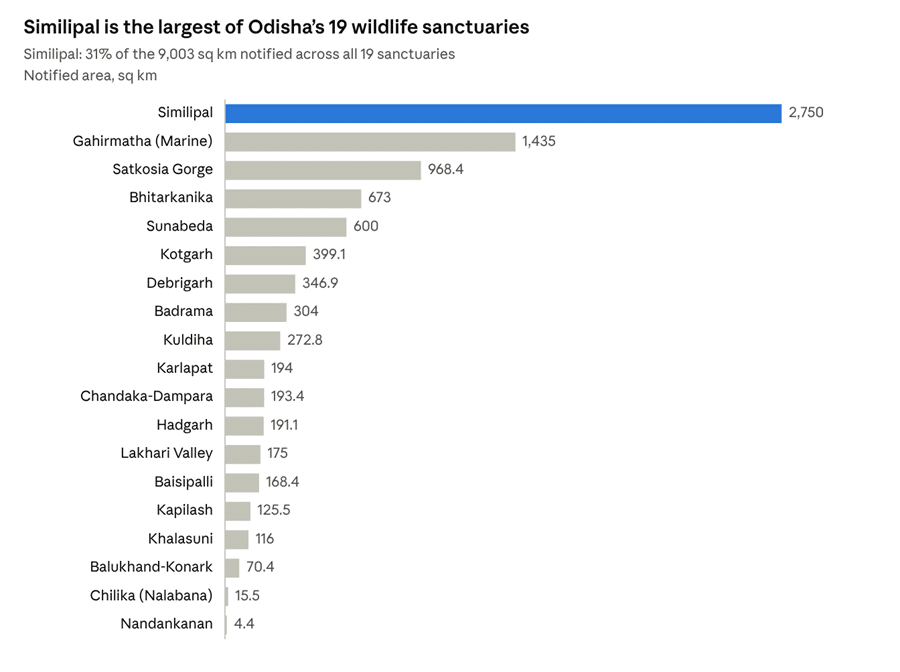
The size distribution is highly skewed. Four sanctuaries — Similipal, Gahirmatha, Satkosia and Bhitarkanika — account for well over half of all notified sanctuary area, and three of them are coastal or riverine wetland systems. At the other end, Nandankanan and Nalabana are tiny by area but carry outsized importance: one is India’s best-known zoo-cum-sanctuary and captive gharial and white-tiger breeding centre, the other is the heart of Asia’s largest brackish-water lagoon bird habitat. Most of the remaining sanctuaries fall in the 100–400 sq km range and are forest blocks of the Eastern Ghats and the Northern Plateau, many of which function as stepping stones in elephant corridors.
Sanctuaries by Region and Ecosystem
1. Northern Plateau: Mayurbhanj, Keonjhar and Balasore
Similipal Wildlife Sanctuary (2,750 sq km, Mayurbhanj) is the largest sanctuary in Odisha and the outer zone of the Similipal Tiger Reserve and Similipal Biosphere Reserve. Its undulating hills rise to Khairiburu (1,168 m) and Meghasani (1,165 m) and are drained by the Budhabalanga, Salandi, Khairi and Palpala rivers, with the Barehipani (about 399 m) and Joranda waterfalls. Moist peninsular sal forest dominates. Similipal is famous for the world’s only wild population of pseudo-melanistic tigers, alongside elephant, gaur, leopard, sambar, mugger and over 300 bird species.
Hadgarh Wildlife Sanctuary (191.06 sq km, Keonjhar) lies around the Salandi reservoir and is contiguous with Similipal to the north. Its mixed deciduous forest and reservoir margins support mugger crocodiles, elephants and leopards.
Kuldiha Wildlife Sanctuary (272.75 sq km, Balasore) sits in the Nilgiri hills and is connected to Similipal through the Sukhupada and Nato hill ranges, forming part of the Similipal–Kuldiha–Hadgarh elephant landscape. Tropical moist and dry deciduous sal forests here harbour elephant, gaur, sambar and giant squirrel.
2. Central Odisha: the Mahanadi and Brahmani Valleys
Satkosia Gorge Wildlife Sanctuary (968.35 sq km) spreads across Angul, Nayagarh, Boudh and Cuttack districts where the Mahanadi cuts a spectacular 22 km gorge through the Eastern Ghats. It is the natural southern limit of the gharial’s range in India, and the Tikarpada gharial and mugger rehabilitation programme operates here. Together with Baisipalli Wildlife Sanctuary (168.35 sq km, Nayagarh), Satkosia forms the Satkosia Tiger Reserve (notified 2007).
Kapilash Wildlife Sanctuary (125.5 sq km, Dhenkanal), notified in 2011, is the youngest sanctuary in the state. Its hills, crowned by the Kapilash temple, carry dry and moist deciduous forest with elephants, leopards and a rich diversity of medicinal plants.
Chandaka-Dampara Wildlife Sanctuary (193.39 sq km, Khordha and Cuttack) is a rare example of an elephant habitat on the edge of a state capital. Its dry deciduous forests and small reservoirs such as Deras and Jhumka supply water to wildlife and protect Bhubaneswar’s catchments.
Nandankanan Wildlife Sanctuary (4.37 sq km, Khordha) combines a zoological park (established 1960), a botanical garden and the Kanjia Lake wetland. It was the world’s first captive breeding centre for gharials (1980) and is known for its white tigers.
3. Western Odisha: Sambalpur, Bargarh and Nuapada
Debrigarh Wildlife Sanctuary (346.90 sq km, Bargarh) lies on the south-western shore of the Hirakud reservoir. Its dry deciduous forests and the reservoir margin support gaur, sambar, chital, leopard and large congregations of wintering waterbirds. After relocation of villages from its core, it was approved as a tiger reserve in 2025, making it Odisha’s third.
Badrama Wildlife Sanctuary (304.03 sq km, Sambalpur), also known as Ushakothi, and Khalasuni Wildlife Sanctuary (116 sq km, Sambalpur) protect dry peninsular sal forests that serve as elephant habitat in the Sambalpur–Deogarh–Angul belt.
Sunabeda Wildlife Sanctuary (600 sq km, Nuapada) occupies a high plateau (about 800–900 m) on the Chhattisgarh border, contiguous with Udanti–Sitanadi Tiger Reserve. It has been proposed as a tiger reserve and supports leopard, sloth bear, wolf, gaur and four-horned antelope.
4. Southern and South-Western Odisha: the Eastern Ghats
Kotgarh Wildlife Sanctuary (399.05 sq km, Kandhamal) protects hill sal forests in the Eastern Ghats and forms elephant habitat linked with the Satkosia landscape.
Lakhari Valley Wildlife Sanctuary (174.95 sq km, Gajapati and Ganjam) protects hill forests of the Eastern Ghats around the Mahendragiri region and is a home for elephants, leopards and sambar.
Karlapat Wildlife Sanctuary (193.998 sq km, Kalahandi), about 12 km from Bhawanipatna, has dry deciduous forest with sal and bamboo, and the popular Phurlijharan waterfall.
5. The Coast: Kendrapara, Bhadrak, Puri and Chilika
Bhitarkanika Wildlife Sanctuary (673 sq km, Kendrapara) lies in the Brahmani–Baitarani estuary and contains the Bhitarkanika National Park in its core. It holds India’s largest population of saltwater crocodiles (over 1,600), along with king cobra, water monitor, and a heronry at Bagagahana. It is a Ramsar Site (2002).
Gahirmatha Marine Wildlife Sanctuary (1,435 sq km, Kendrapara and Bhadrak) is mainly sea area off the Bhitarkanika coast. It protects one of the world’s largest mass-nesting (arribada) beaches of the Olive Ridley sea turtle.
Balukhand-Konark Wildlife Sanctuary (70.40 sq km, Puri) stretches along the coast between Puri and Konark. Its casuarina, cashew and coastal scrub support blackbuck, spotted deer and jackal.
Chilika (Nalabana) Bird Sanctuary (15.53 sq km), an island in Chilika Lake spread over Khordha, Puri and Ganjam, is the core roosting ground for several lakh migratory waterbirds each winter, arriving from as far as the Caspian Sea, Siberia and Central Asia. Chilika was India’s first Ramsar Site (1981).
Special-Purpose Sanctuaries and Wider Conservation Units
Marine sanctuary
Gahirmatha is Odisha’s only marine sanctuary and one of very few in India. Each winter, lakhs of Olive Ridley turtles congregate offshore and nest en masse on the beaches of the Gahirmatha coast (Nasi islands and Ekakulanasi). Odisha also protects the Rushikulya and Devi river mouths, the two other mass-nesting sites, through seasonal fishing bans (1 November to 31 May) within 20 km of the coast and turtle-excluder device rules for trawlers.
Bird sanctuaries and wetlands
Nalabana in Chilika is the state’s only notified bird sanctuary. Bird life is also a major value of Bhitarkanika (heronry and mangrove birds), Debrigarh and the Hirakud reservoir (a Ramsar Site since 2021), and the Satkosia Gorge. Odisha now has six Ramsar Sites: Chilika, Bhitarkanika, Hirakud, Satkosia Gorge, Tampara and Ansupa.
Crocodile sanctuaries
Odisha is the only state in India where all three crocodilian species live in the wild, and its sanctuaries were central to the Crocodile Conservation Project launched in 1975 with FAO/UNDP support:
- Saltwater crocodile — Bhitarkanika (Dangmal breeding centre).
- Gharial — Satkosia Gorge (Tikarpada) and Nandankanan.
- Mugger — Hadgarh, Similipal (Ramtirtha) and Satkosia.
Elephant sanctuaries and elephant reserves
Most inland sanctuaries are elephant habitat. Under Project Elephant, Odisha has notified three elephant reserves that link several sanctuaries:
- Mayurbhanj Elephant Reserve — Similipal, Hadgarh and Kuldiha.
- Mahanadi Elephant Reserve — Satkosia Gorge and Baisipalli.
- Sambalpur Elephant Reserve — Badrama and Khalasuni.
The state has also identified about 14 elephant corridors connecting these forest blocks.
Tiger reserves
Three of Odisha’s tiger reserves are built around sanctuaries:
| Tiger reserve | Year | Sanctuaries / park included |
|---|---|---|
| Similipal | 1973 (one of India’s first nine) | Similipal NP + Similipal WLS |
| Satkosia | 2007 | Satkosia Gorge WLS + Baisipalli WLS |
| Debrigarh | 2025 (approved) | Debrigarh WLS |
Sunabeda has long been proposed as a fourth tiger reserve.
Eco-sensitive zones
Following Supreme Court directions and the Ministry of Environment, Forest and Climate Change (MoEFCC) guidelines of 2011, an eco-sensitive zone (ESZ) has to be notified around every sanctuary and national park as a buffer where mining, polluting industries and major construction are regulated. Final ESZ notifications have been issued for most of Odisha’s sanctuaries; the width varies from zero on some boundaries to several kilometres elsewhere.
Challenges and Management
Key challenges
- Human–elephant conflict — Odisha records some of India’s highest numbers of human deaths from elephant encounters, along with crop and house damage. Fragmented sanctuaries such as Chandaka, Kapilash, Badrama and Khalasuni lie close to farmland, highways and mines, and elephants routinely move outside their boundaries.
- Electrocution and poaching — illegal live-wire snares and sagging power lines kill elephants and other animals; bushmeat hunting during traditional hunting festivals (such as Akhand Shikar in Similipal) has been a long-standing problem.
- Habitat fragmentation — mining in Keonjhar, Sundargarh and Angul, new railway lines and widened highways cut across corridors linking Similipal, Hadgarh, Kuldiha and Satkosia.
- Villages inside sanctuaries — several sanctuaries have resident villages whose grazing, firewood collection and shifting cultivation pressure the habitat, while their own rights and livelihoods need to be protected.
- Forest fires — in the dry season (February to May), fires set for mahua-flower collection or clearing can spread widely, as happened in Similipal in 2021.
- Coastal pressures — trawler fishing, aquaculture ponds and shoreline erosion threaten Gahirmatha’s turtles and Bhitarkanika’s mangroves, while saltwater crocodile–human encounters are rising around Bhitarkanika.
- Low tiger numbers — the Satkosia tiger translocation of 2018 failed amid local opposition, and Satkosia has very few resident tigers.
Management measures
- Wildlife Wing and divisions — sanctuaries are managed through dedicated wildlife divisions (for example, Mangrove Forest Division at Rajnagar, Hirakud Wildlife Division, Satkosia Wildlife Division) headed by the Principal Chief Conservator of Forests (Wildlife) and Chief Wildlife Warden.
- Voluntary relocation — relocation of villages from the cores of Similipal, Debrigarh and Satkosia under the centrally sponsored scheme has created inviolate spaces; Debrigarh’s success led to its tiger reserve status.
- Eco-development committees (EDCs) — villages around sanctuaries participate in protection and earn incomes through eco-tourism, as at Debrigarh, Satkosia, Bhitarkanika and Similipal.
- Anti-depredation squads and early-warning systems to reduce elephant conflict, and ex-gratia compensation for loss of life and crops.
- Technology — camera traps, drone surveillance, M-STrIPES patrolling and radio-collaring of elephants and tigers.
- Seasonal protection — the annual Olive Ridley fishing ban, and crocodile counts and turtle nest monitoring every year.
- Eco-tourism — nature camps managed by local communities (Ecotour Odisha) provide alternative livelihoods and an incentive for local support.
Conclusion
Odisha’s 19 wildlife sanctuaries capture almost every major ecosystem of eastern India in one state — from the sal-clad hills of Similipal and the Eastern Ghats to the Mahanadi gorge, the Hirakud reservoir, the mangrove creeks of Bhitarkanika and the turtle beaches of Gahirmatha. They hold all three Indian crocodilians, one of the world’s largest Olive Ridley rookeries, India’s only melanistic tigers in the wild, and a large share of the country’s elephants. Their future depends on keeping the corridors between them open and on making conservation worthwhile for the people who live around them.
Quick Facts
| Item | Fact |
|---|---|
| Number of wildlife sanctuaries | 19 |
| Total protected areas | 21 (2 national parks + 19 sanctuaries) |
| Protected-area network | about 8,380 sq km (about 5.4% of the state) |
| Largest sanctuary | Similipal — 2,750 sq km |
| Smallest sanctuary | Nandankanan — 4.37 sq km |
| Youngest sanctuary | Kapilash — 2011 |
| Only marine sanctuary | Gahirmatha — 1,435 sq km |
| Only bird sanctuary | Chilika (Nalabana) — 15.53 sq km |
| Saltwater crocodile stronghold | Bhitarkanika |
| Gharial habitat | Satkosia Gorge |
| Sanctuaries in tiger reserves | Similipal, Satkosia Gorge, Baisipalli, Debrigarh |
Sources
- Protected Areas — Wildlife Odisha (Odisha Forest Department) — official list, districts, notified areas and notification dates of all 19 sanctuaries.
- Odisha Forest Department, Odisha Forestry Sector at a Glance 2023 — total protected-area network.
- Wildlife (Protection) Act, 1972 — Section 18 (declaration of sanctuaries).
- MoEFCC, Guidelines for declaration of Eco-Sensitive Zones around National Parks and Wildlife Sanctuaries (2011).