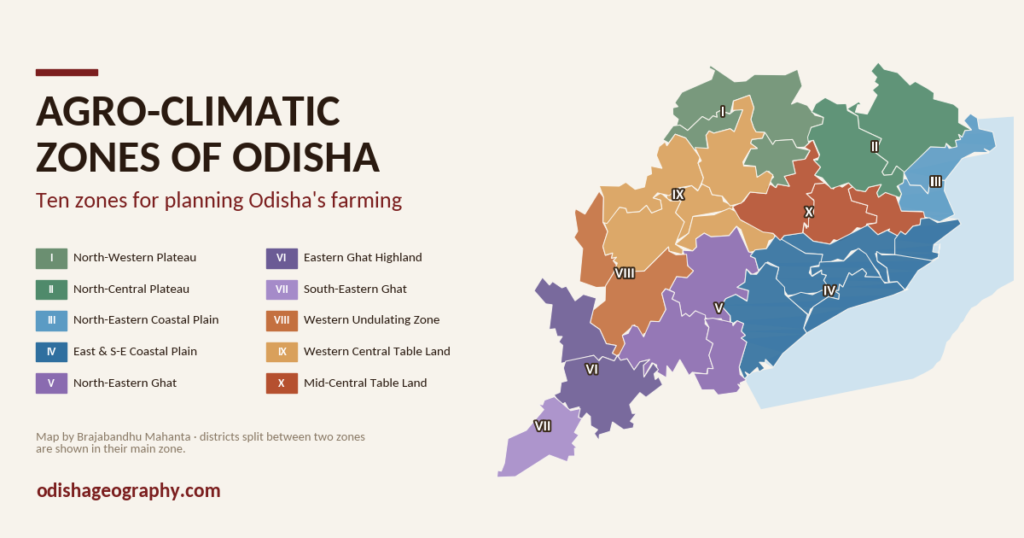

Agriculture remains the main source of livelihood for the majority of Odisha’s workforce, and agriculture and allied sectors still contribute about a fifth of the state’s economy, a higher share than the national average. What Odisha grows, and how well it grows it, therefore matters both for food security and for the incomes of millions of rural households.
Odisha’s crops are shaped by a distinctive physical setting: a humid tropical monsoon climate with about 1,450 mm of rain concentrated in June to September; fertile alluvial deltas along the coast; red, lateritic and mixed soils on the plateaus and hills; and a long coastline exposed to cyclones. Within this setting, farmers grow a wide range of crops, from paddy in the deltas to ragi and niger on the hill slopes of Koraput, cotton in Kalahandi, cashew on the lateritic coast and turmeric in Kandhamal.
This article examines each of Odisha’s major crops in turn: the geographical conditions it needs, where it is grown, how much is produced, how productive it is compared with India as a whole, and the problems and prospects it faces. A companion article on this site, Cropping Seasons and Cropping Patterns in Odisha, explains how these crops fit into the seasons and the overall cropping pattern; this article focuses on the crops themselves.
Classification of crops grown in Odisha
Crops can be classified in several ways. For geography and for exam answers, three classifications are most useful.
1. By use
| Group | Meaning | Main crops in Odisha |
|---|---|---|
| Food crops: cereals | Grains that form the staple diet | Rice (dominant), maize, ragi, small millets (suan, kodo, kangu), a little wheat |
| Food crops: pulses | Protein-rich legumes | Green gram (mung), black gram (biri), arhar (red gram), horse gram (kulthi), field pea, chickpea, lentil, khesari |
| Oilseeds | Seeds crushed for edible oil | Groundnut, sesamum (til), mustard, niger, sunflower, linseed, castor |
| Fibre crops | Grown for fibre | Cotton, jute, mesta |
| Sugar crops | Grown for sugar and jaggery | Sugarcane |
| Horticultural crops | Vegetables, fruits, flowers, spices | Brinjal, tomato, potato, onion, sweet potato, mango, banana, jackfruit, turmeric, ginger, chilli |
| Plantation crops | Perennial tree crops, often commercial | Cashew, coconut, coffee, betel vine, areca nut |
2. By season
- Kharif crops (sown with the monsoon, June–July): paddy, maize, ragi and millets, arhar, kharif groundnut, til, niger, cotton, jute.
- Rabi crops (sown after the monsoon, October–December): green gram and black gram (paira), mustard, rabi groundnut, sunflower, potato and winter vegetables, field pea, wheat.
- Summer crops (with irrigation, January–May): dalua paddy, summer green gram, til, watermelon and cucurbits.
3. By economic purpose
- Subsistence crops are grown mainly for household consumption: paddy on small farms, millets in tribal areas, pulses for the family.
- Commercial or cash crops are grown mainly for sale: cotton, sugarcane, jute, groundnut, vegetables, cashew, turmeric, coffee and betel vine.
In practice, the line between them is blurring. Paddy, once grown mainly for home consumption, is now also an important cash crop because of government procurement, while vegetables and maize are grown increasingly for urban and industrial markets.
Rice (paddy): the king of Odisha’s crops
Importance
Rice is the staple food of Odisha and the state’s most important crop by every measure: area, production, employment and culture. It occupies about 38 to 42 lakh ha each year, around 44 to 45% of the gross cropped area, and is grown in every district. Odisha is now a rice-surplus state and one of the major contributors of rice to the central pool. Under decentralised procurement, the state government procured about 70.9 lakh tonnes of paddy (about 48 lakh tonnes of rice) in the Kharif Marketing Season 2023-24, from lakhs of registered farmers. Rice is also central to Odia culture: Nuakhai, the harvest festival of western Odisha, celebrates the new rice, and rice dishes such as pakhala are part of everyday life.
Geographical conditions
- Temperature: a hot and humid climate with temperatures of 20 to 35 °C during the growing season. Odisha’s tropical climate allows rice to be grown in all three seasons where water is available.
- Rainfall and water: 100 to 200 cm of rainfall, or equivalent irrigation. Transplanted paddy needs standing water in the field for much of its life. Odisha’s monsoon rainfall of about 120 cm in four months suits it well.
- Soils: clayey and clay-loam soils that hold water, such as the alluvial soils of the deltas and the heavy soils of low-lying valley floors. Rice can also grow in mildly saline and acidic soils with suitable varieties.
- Relief: flat or gently sloping land, terraced valleys and low-lying areas where water collects. Uplands are suitable only for short-duration direct-seeded varieties.
- Labour: rice cultivation, especially transplanting and harvesting, needs abundant cheap labour, which Odisha’s dense rural population provides.
Types of rice cultivation
Odisha’s rice is classified by season and by land type. Beali (autumn) paddy is a short-duration, direct-seeded crop of the uplands; sarad (winter) paddy is the main transplanted crop of medium and low lands; and dalua (summer) paddy is grown with irrigation in the dry season. By land type, rice is grown on rainfed uplands, rainfed shallow lowlands, deep-water and flood-prone lowlands, coastal saline lands and irrigated lands. Each needs different varieties and practices.
Varieties and research
Odisha hosts the ICAR-National Rice Research Institute (NRRI) at Cuttack, set up in 1946 as the Central Rice Research Institute, which has developed many varieties suited to eastern India. Odisha University of Agriculture and Technology (OUAT), Bhubaneswar, has also released many varieties. Widely grown varieties include Swarna (MTU 7029), Pooja, Lalat, Pratikshya and newer CR Dhan varieties. Two kinds are especially important for Odisha’s risky environment:
- Submergence-tolerant varieties such as Swarna-Sub1, which can survive two weeks under floodwater, for the flood-prone deltas.
- Drought-tolerant varieties such as Sahbhagi Dhan for the rainfed uplands of western Odisha.
The Koraput region (Jeypore tract) is one of the world’s centres of rice diversity, with hundreds of traditional landraces. FAO recognised the traditional agriculture of Koraput as a Globally Important Agricultural Heritage System (GIAHS) in 2012. Aromatic local rice such as Kalajeera of Koraput is now marketed as a premium product.
Distribution
- Coastal deltas: Cuttack, Jagatsinghapur, Kendrapara, Puri, Khordha, Jajapur, Bhadrak, Baleshwar and Ganjam have the largest areas under paddy and the oldest canal systems (Mahanadi delta, Taladanda and Kendrapara canals, Rushikulya system).
- Hirakud command (western Odisha): Bargarh, the ‘rice bowl of Odisha’, together with Sambalpur and Subarnapur, grows both kharif and rabi paddy with canal irrigation and is the state’s leading paddy procurement district.
- Other areas: Kalahandi (helped by Upper Indravati irrigation), Nabarangapur, Koraput and Malkangiri (helped by Upper Kolab, Indravati and Balimela systems), and valley lands in Mayurbhanj, Kendujhar and Sundargarh.
Production and productivity
In 2017-18, the latest year for which I could access the full official crop statistics, Odisha produced about 65.5 lakh tonnes of rice from about 37.7 lakh ha, an average yield of about 1.7 tonnes per hectare. Kharif rice yielded about 1.65 t/ha, while irrigated rabi-summer rice yielded about 3.1 t/ha. Production has risen since then with better irrigation and seeds; the Odisha Economic Survey 2025-26 reports a record foodgrain output of about 150 lakh tonnes in 2024-25, of which rice is the overwhelming part. Even so, average yield remains below the national average, because most kharif paddy is rainfed.
Problems
- Rainfed cultivation and climatic risk: drought in western Odisha, floods in the deltas and cyclones on the coast regularly damage the crop.
- Low productivity: low use of quality seed and balanced fertilisers, poor water control and small fragmented holdings.
- Pests and diseases: brown planthopper, stem borer, blast and bacterial leaf blight cause heavy losses in some years.
- Post-harvest and procurement issues: delays in procurement, deductions at mandis (‘katni-chhatni’) and distress sales below MSP are recurring complaints.
- Over-dependence: paddy on uplands with low yields, and the high water use of summer paddy, raise questions of sustainability.
Prospects
Odisha’s rice yields can be raised substantially through irrigation, stress-tolerant varieties, line transplanting and the System of Rice Intensification (SRI), mechanisation, and better pest management. At the same time, shifting low-yielding upland paddy to pulses, oilseeds and millets would make the system more profitable and resilient.
How productive are Odisha’s crops?
Before looking at the other crops one by one, it helps to see the common thread that runs through all of them: low productivity.

In 2017-18 Odisha’s average yields of rice, pulses and oilseeds were all only about 60 to 70% of the national average. The reasons are shared across crops: most cultivation is rainfed, farms are small and fragmented, use of improved seed, fertiliser and machinery is low, and weather shocks (drought, floods and cyclones) frequently cut yields. The gap is also an opportunity: raising Odisha’s yields even to the national average would increase output by roughly half without adding a single hectare of land. Irrigated summer paddy, which yields almost twice as much as rainfed kharif paddy in the state, shows what better water control can achieve.
Pulses
Importance
Pulses are Odisha’s second most important crop group, covering about 20 to 21 lakh ha, roughly a quarter of the gross cropped area. In 2017-18 the state produced about 10.8 lakh tonnes of pulses. Pulses matter for three reasons. They are the main source of protein in a largely vegetarian rural diet; as legumes, they fix atmospheric nitrogen through root nodules and improve soil fertility for the following paddy crop; and, being short-duration and low-water crops, they are ideal for using the residual moisture left after the kharif harvest. Nearly two-thirds of Odisha’s pulse area is sown in the rabi season.
Geographical conditions
Most pulses need a moderate temperature of 20 to 30 °C, light to moderate rainfall or residual moisture (40 to 60 cm is enough), and well-drained loamy or clay-loam soils. They cannot tolerate waterlogging, and heavy rain at flowering or harvest damages them. This is why kharif pulses are grown on uplands and rabi pulses on medium and low lands after the monsoon has ended.
Major pulses
Green gram (mung). The most widely grown pulse in Odisha, covering about 8.7 lakh ha in 2014-15. It is a short-duration crop of 60 to 70 days. Most green gram is sown as a paira (utera) relay crop in the coastal districts: seeds are broadcast into standing paddy shortly before harvest so that they germinate on the remaining moisture. It is also grown in summer under irrigation and in kharif on uplands. Major districts include Cuttack, Puri, Khordha, Jajapur, Bhadrak, Baleshwar, Kendrapara, Jagatsinghapur and Ganjam.
Black gram (biri). The second major pulse, about 5.7 lakh ha in 2014-15. It is grown in much the same way and areas as green gram, mostly as a rice-fallow crop in the coastal belt, and also in kharif on uplands in central and western Odisha. Biri is central to Odia cuisine, used in bara, chakuli pitha, arisa and other dishes.
Arhar (red gram, tur). A long-duration kharif crop (about 6 to 9 months) of uplands, covering about 1.4 lakh ha in 2014-15. It is drought-hardy, deep-rooted and often intercropped with groundnut, maize, upland paddy or millets. It is concentrated in western and southern Odisha: Kalahandi, Balangir, Nuapada, Rayagada, Koraput, Kandhamal and Bargarh.
Horse gram (kulthi). A very hardy pulse of poor, stony uplands, grown late in kharif on residual moisture by small and tribal farmers in Kalahandi, Balangir, Nuapada, Kandhamal, Koraput, Rayagada and Mayurbhanj. It survives where few other crops can and is valued for both food and fodder.
Other pulses. Field pea, chickpea (gram), lentil and khesari (grass pea) are rabi pulses grown on small areas, mainly under residual moisture or light irrigation in central and western Odisha. Cowpea is grown as a vegetable and fodder legume.
Problems
- Very low yields, about 500 kg/ha against a national average of about 850 kg/ha, because pulses are grown without irrigation, fertiliser or plant protection, and often with farmers’ own old seed.
- Yellow mosaic virus in green and black gram, pod borers in arhar, and untimely rain at harvest cause heavy losses.
- Broadcast relay sowing in standing paddy gives uneven plant stands.
- Weak marketing: procurement of pulses at MSP is limited, so prices often fall at harvest.
Prospects
Pulses are central to Odisha’s plans for crop diversification and rice-fallow management. Quality seed of short-duration, virus-resistant varieties, seed drills for sowing after paddy, one or two protective irrigations, and assured procurement can sharply raise both area and yield. Since pulses improve the soil and need little water, expanding them also makes the farming system more sustainable.
Oilseeds
Importance
Oilseeds cover about 6 to 7 lakh ha in Odisha, and in 2017-18 the state produced about 5.4 lakh tonnes of oilseeds. This is far below the state’s requirement of edible oil, so Odisha depends heavily on oil from other states and imports. Oilseeds are also valuable as cash crops for small farmers on uplands and as a second crop on rice fallows, and their oilcake is used as cattle feed and organic manure. Unlike paddy and pulses, oilseeds are split fairly evenly between kharif and rabi.
Major oilseeds
Groundnut. Groundnut is the leading oilseed of Odisha, covering about 2.6 lakh ha in 2014-15.
- Conditions: warm climate (20 to 30 °C), 50 to 75 cm of rain, and light, sandy-loam or red, well-drained soils, because the pods develop underground and need loose soil. It cannot stand waterlogging or frost.
- Distribution: kharif groundnut is grown on uplands in Dhenkanal, Anugul, Nayagarh, Ganjam, Kendujhar and Mayurbhanj; rabi and summer groundnut, which yields better, is grown under irrigation on the sandy and red soils of Ganjam, Puri, Khordha, Nayagarh, Cuttack, Baleshwar and the river islands.
Sesamum (til). About 2.3 lakh ha in 2014-15, sesamum is a hardy crop that grows with little water on light soils. It is grown in kharif on uplands of western and central Odisha (Balangir, Bargarh, Kalahandi, Nuapada, Subarnapur, Baudh) and as a summer crop on residual moisture in coastal districts. Odisha’s til is of good quality and is also used in sweets and religious offerings.
Mustard and rapeseed. About 1.2 lakh ha in 2014-15. A rabi crop that needs cool, dry weather and irrigation or good residual moisture. It is grown in the cooler interior and northern districts, such as Mayurbhanj, Kendujhar, Sundargarh, Kandhamal, Koraput and Kalahandi, and in irrigated pockets of the coast. Mustard oil is the traditional cooking oil of Odisha.
Niger. Niger is a distinctive oilseed of Odisha’s tribal highlands and the state is one of the leading niger-producing states of India. It is grown in late kharif on poor, sloping, low-fertility land with almost no inputs, chiefly in Koraput, Rayagada, Nabarangapur, Malkangiri, Kandhamal, Kalahandi and Mayurbhanj. Its yellow flowers carpet the Eastern Ghats in October and November. Niger oil is used for cooking by tribal families, and niger seed is exported as bird feed.
Sunflower, linseed and castor. Sunflower is a minor rabi crop under irrigation, linseed is a rice-fallow crop on residual moisture, and castor is grown on uplands in western Odisha.
Problems and prospects
Oilseed yields in Odisha are low, around 890 kg/ha against about 1,280 kg/ha nationally (2017-18). The crop is often grown on marginal land without fertiliser or irrigation, and farmers lack quality seed, especially hybrid seed for groundnut and sunflower. Pest and disease attacks (leaf spot and rust in groundnut, aphids in mustard) and poor marketing reduce returns.
The prospects, however, are good. Rice fallows and uplands offer large areas for expansion; rabi groundnut and mustard under irrigation yield well; and national programmes such as the National Mission on Edible Oils support seed, demonstrations and processing. Expanding oilseeds would reduce Odisha’s dependence on edible oil from outside and raise farm incomes.
Maize, millets and wheat
Apart from rice, cereals cover only about 4 lakh ha in Odisha, but they are extremely important for the food security and nutrition of tribal and upland communities, and maize is emerging as a commercial crop.
Maize
Conditions. Maize needs a warm climate (21 to 27 °C), 50 to 100 cm of well-distributed rain, and fertile, well-drained loamy soils. It cannot tolerate waterlogging, so in Odisha it is a crop of uplands and slopes.
Distribution and trends. Maize covered about 2.7 lakh ha in 2014-15. It is concentrated in the southern highlands, with Nabarangapur the leading district, followed by Koraput, Rayagada, Gajapati, Kalahandi, Malkangiri and Kandhamal; it is also grown in Mayurbhanj, Kendujhar and Sundargarh. Over the last two decades maize has expanded rapidly in Nabarangapur and neighbouring districts, where hybrid maize grown under contract and sold to traders supplies the poultry feed and starch industries of Andhra Pradesh and Telangana. Maize is grown mainly in kharif, with some rabi maize under irrigation.
Issues. Rapid expansion of hybrid maize on slopes has raised concerns about soil erosion, heavy use of chemicals, and dependence of tribal farmers on outside traders and fluctuating prices.
Ragi (finger millet)
Importance. Ragi is the most important millet of Odisha, covering about 1.6 lakh ha in 2014-15. It is rich in calcium, iron and fibre, and is a staple food of many tribal communities, eaten as mandia jau (gruel) and mandia pitha.
Conditions and distribution. Ragi is drought-tolerant and grows on poor, shallow red and lateritic soils of hill slopes with modest rainfall. It is concentrated in Koraput, Rayagada, Malkangiri, Nabarangapur, Gajapati, Kandhamal, Kalahandi and Sundargarh.
Small millets
Small millets such as suan (little millet), kodo, kangu (foxtail millet) and jowar (sorghum) are traditional crops of the tribal hills, often grown in mixtures with pulses and oilseeds on shifting cultivation plots. They need very little water and inputs, mature quickly and store well, which makes them a reliable insurance against drought and hunger.
Decline and revival. For decades, millet area declined as public distribution of cheap rice, changing food habits and lower prices made paddy and maize more attractive. Since 2017, the Odisha Millets Mission has worked to reverse this decline by supporting improved cultivation practices, community seed banks, procurement of ragi at the minimum support price, processing units, and the inclusion of millets in the public distribution system, ICDS take-home rations and school meals. Odisha’s model has been widely cited as an example during the International Year of Millets (2023).
Wheat
Wheat is a minor crop in Odisha, covering only about 0.1 lakh ha. The main reasons are geographical: wheat needs a cool growing season of four to five months with temperatures of 10 to 15 °C at sowing and 21 to 26 °C at ripening, but Odisha’s winter is short and warm, and temperatures rise quickly from February. Limited irrigation and the competition of more profitable rabi crops also restrict it. Small areas are grown under irrigation in the northern and western districts such as Sundargarh, Sambalpur, Bargarh and Mayurbhanj.
Fibre and cash crops
Cotton
Importance. Cotton is the most important fibre crop and one of the main cash crops of western and southern Odisha, covering about 1.3 lakh ha in 2014-15. For many small and tribal farmers in the region it is the main source of cash income.
Conditions. Cotton needs a long frost-free period of about 200 days, high temperatures (21 to 30 °C), moderate rainfall of 50 to 100 cm with a dry spell at boll formation and picking, and plenty of sunshine. It grows best on the moisture-retentive black soils and mixed red-and-black soils.
Distribution. Cotton is concentrated in the Western Undulating zone and the south-west: Kalahandi and Rayagada are the leading districts, followed by Balangir, Nuapada, Bargarh, Koraput and Gajapati. Kalahandi’s black soils and the transition from drought-prone farming to cash cropping have made cotton a major crop there. Almost all of it is rainfed kharif cotton, and most is now Bt cotton.
Problems. Rainfed cotton is very sensitive to drought and to excessive rain at picking. Pink bollworm resistance to Bt cotton, high cost of seed and pesticides, lack of ginning and spinning units within the state, and price fluctuations have led to farm distress in the cotton belt. Most raw cotton is sold to traders and processed outside Odisha.
Jute and mesta
Conditions. Jute needs a hot and humid climate (24 to 35 °C), heavy rainfall of 150 to 250 cm, well-drained fertile alluvial soils renewed by floods, and abundant clean water for retting (soaking the stems to separate the fibre). Mesta (kenaf/roselle) is a hardier substitute that tolerates poorer soils and less rain.
Distribution. In Odisha jute is grown on a small area in the northern coastal districts that border West Bengal, mainly Baleshwar, Bhadrak, Jajapur, Kendrapara and Cuttack. Mesta is grown more widely, including on uplands in Kalahandi and Rayagada.
Decline. Jute area has fallen to only a few thousand hectares (about 0.08 lakh ha in 2014-15) because of low prices, competition from synthetic packaging, the closure of jute mills, and the shift of farmers to paddy and vegetables.
Sugarcane
Conditions. Sugarcane is a long-duration (10 to 18 months) tropical crop needing high temperatures (21 to 27 °C), 75 to 150 cm of rain or assured irrigation, and deep, fertile, well-drained loamy soils. It needs heavy inputs of water, fertiliser and labour.
Distribution. Sugarcane covers only about 0.3 lakh ha, mostly under irrigation in Ganjam, Nayagarh, Bargarh, Koraput, Nabarangapur, Mayurbhanj, Dhenkanal and Kalahandi. Its yield in Odisha, about 74 tonnes per hectare in 2017-18, is close to the national average of about 80 t/ha.
Decline. Area and production have fallen sharply over the last three decades as many cooperative sugar mills closed, payments to cane growers were delayed and farmers turned to less risky crops. Much of the cane now goes to jaggery (gud) making.
Horticulture and plantation crops
Horticulture is the fastest-growing part of Odisha’s agriculture and gives much higher income per hectare than cereals. According to the state’s investment promotion agency (Invest Odisha), Odisha ranks first in India in sweet potato and paddy straw mushroom, second in brinjal and cabbage, and third in cashew nut production.
Vegetables
Vegetables cover about 6.5 lakh ha, more than half in the rabi season. The main vegetables are brinjal, tomato, okra (bhindi), cauliflower, cabbage, pumpkin, gourds, beans, potato, onion and sweet potato, along with leafy greens.
- Conditions: vegetables need fertile, well-drained soils, regular irrigation and quick access to markets because they are perishable.
- Distribution: (a) the peri-urban belt around Bhubaneswar, Cuttack, Berhampur, Sambalpur and Rourkela; (b) river valleys, islands and chars with fertile silt in the Mahanadi, Brahmani and Baitarani deltas; (c) the cool highlands of Koraput, Kandhamal and Rayagada, which supply off-season vegetables such as cabbage, tomato and beans to plains markets and neighbouring states.
- Potato and onion: Odisha depends heavily on West Bengal and other states for potato and onion. The state has launched missions to expand potato cultivation and cold storage to become self-sufficient.
Fruits
- Mango: the most widely grown fruit, found in homestead orchards across the state, with commercial orchards in Koraput, Rayagada, Mayurbhanj, Kendujhar and Gajapati. Tribal farmers have benefited from the WADI (tree-based farming) model of mango orchards.
- Banana, papaya and pineapple: banana is grown in the coastal districts and western Odisha; pineapple on the hill slopes of Gajapati, Rayagada and Mayurbhanj.
- Jackfruit and citrus: jackfruit is common in homesteads, and oranges and other citrus grow in the cooler hills of Koraput and Kandhamal.
Spices
- Turmeric: Kandhamal Haladi, an organic turmeric grown by tribal farmers on the hill slopes of Kandhamal, received a Geographical Indication (GI) tag in 2019. Turmeric is also grown in Koraput, Rayagada and Gajapati.
- Ginger, chilli and garlic: ginger in the highland districts, chilli in western Odisha and the coast, and garlic in Koraput and Kalahandi.
Plantation crops
Cashew. Cashew is Odisha’s most important plantation crop and the state is among the top three producers in India. It grows on the lateritic and sandy coastal uplands where few other crops thrive, in Ganjam, Gajapati, Puri, Khordha, Nayagarh, Baleshwar, Jajapur, Dhenkanal and parts of Koraput. Cashew suits poor soils, controls erosion and provides cash income, while processing units in Ganjam and elsewhere employ many women. Ageing plantations and low yields are the main problems.
Coconut. Coconut grows along the entire coastal belt, especially in Puri, Ganjam, Jagatsinghapur, Kendrapara, Khordha and Baleshwar, on sandy soils with a humid climate and a high water table. Cyclones such as the 1999 super cyclone and Fani (2019) destroyed vast numbers of trees, which shows how vulnerable coastal plantations are.
Coffee. Coffee is grown on a small scale in the Koraput hills at altitudes of about 900 metres and above, under shade trees, where cool temperatures and good rainfall allow it. It is promoted by the state’s tribal development and coffee development programmes as a high-value crop for tribal farmers.
Betel vine (paan). Betel leaf is grown in specially built shaded enclosures (baraja) in the coastal districts, especially Jagatsinghapur, Puri, Cuttack and Khordha, and is sent to markets across India. Odisha betel leaf has a strong reputation, but cyclones and land acquisition have affected the betel vine areas.
Crops and their leading areas at a glance
The table brings together the main crops, the conditions they need and the districts where they are most important. It is a useful revision tool for map-based and short-answer questions.
| Crop | Season | Key geographical conditions | Leading districts / areas |
|---|---|---|---|
| Rice | Kharif (sarad, beali), summer (dalua) | Hot, humid; 100–200 cm rain or irrigation; clayey alluvium; flat low land | Bargarh (‘rice bowl’), Sambalpur, coastal deltas (Cuttack, Kendrapara, Jagatsinghapur, Puri, Baleshwar, Bhadrak, Ganjam), Kalahandi |
| Green gram, black gram | Rabi (paira), summer | Residual moisture; 20–30 °C; no waterlogging | Coastal districts: Cuttack, Puri, Khordha, Jajapur, Bhadrak, Baleshwar, Kendrapara |
| Arhar, horse gram | Kharif (uplands) | Drought-hardy; light, well-drained soils | Kalahandi, Balangir, Nuapada, Rayagada, Koraput, Kandhamal |
| Groundnut | Kharif and rabi | Warm; light sandy-loam or red soils | Ganjam, Puri, Khordha, Nayagarh, Dhenkanal, Anugul, Cuttack |
| Sesamum (til) | Kharif, summer | Hardy; light soils; little water | Balangir, Bargarh, Kalahandi, Nuapada, Subarnapur, Baudh |
| Mustard | Rabi | Cool, dry winter; irrigation | Mayurbhanj, Kendujhar, Sundargarh, Kandhamal, Koraput |
| Niger | Late kharif | Poor, sloping hill land; low inputs | Koraput, Rayagada, Nabarangapur, Malkangiri, Kandhamal, Kalahandi |
| Maize | Kharif (some rabi) | Warm; well-drained fertile uplands | Nabarangapur (leading), Koraput, Rayagada, Gajapati, Kalahandi |
| Ragi and small millets | Kharif | Drought-tolerant; shallow red and lateritic soils of hills | Koraput, Rayagada, Malkangiri, Nabarangapur, Gajapati, Kandhamal |
| Cotton | Kharif | Black and mixed red-black soils; long frost-free season | Kalahandi, Rayagada, Balangir, Nuapada, Bargarh |
| Jute | Kharif | Hot, humid; heavy rain; alluvium; water for retting | Baleshwar, Bhadrak, Jajapur, Kendrapara, Cuttack |
| Sugarcane | Annual | Irrigation; deep fertile loam | Ganjam, Nayagarh, Bargarh, Koraput, Mayurbhanj |
| Cashew | Plantation | Lateritic and sandy coastal uplands | Ganjam, Gajapati, Puri, Khordha, Nayagarh, Baleshwar |
| Coconut | Plantation | Coastal sandy soils; humid; high water table | Puri, Ganjam, Jagatsinghapur, Kendrapara, Khordha |
| Turmeric | Kharif (annual) | Warm, humid hills; well-drained loam | Kandhamal (GI tag), Koraput, Rayagada, Gajapati |
| Coffee | Plantation | Cool hills above about 900 m; shade | Koraput |
| Betel vine | Perennial (shaded) | Humid coastal climate; shaded enclosures | Jagatsinghapur, Puri, Cuttack, Khordha |
The spatial logic of Odisha’s crops
A clear spatial pattern emerges from the table:
- The coastal plains and deltas specialise in paddy, rabi pulses, vegetables, coconut, betel vine, jute and cashew, reflecting alluvial soils, high rainfall, irrigation, and nearness to markets.
- The western plains and undulating uplands combine irrigated paddy (Hirakud) with cotton, til, arhar, kulthi and groundnut on drier land, reflecting lower and less reliable rainfall and black or mixed soils.
- The southern and northern highlands are the home of maize, ragi and small millets, niger, turmeric, ginger, coffee, highland vegetables and fruits, reflecting slopes, red and lateritic soils, cooler temperatures and tribal farming traditions.
In short, paddy follows water and flat land; other crops follow slopes, soil types and markets.
Common problems and development programmes
Problems shared by Odisha’s crops
- Dependence on the monsoon. Less than half the cropped area is irrigated, so most crops depend on rain. A late onset, a long dry spell or excessive rain at harvest can ruin a season.
- Natural disasters. Odisha is one of India’s most disaster-prone states. Cyclones (1999 super cyclone, Phailin 2013, Hudhud 2014, Titli 2018, Fani 2019) flatten paddy, coconut, banana and betel vine; floods in the Mahanadi, Brahmani and Baitarani deltas submerge crops; and droughts hit the western districts repeatedly.
- Low productivity. Yields of rice, pulses and oilseeds are only about two-thirds of the national average, as the chart above shows, due to poor seed replacement, low fertiliser use, weak extension and limited mechanisation.
- Small and fragmented holdings. About 93% of farmers are small or marginal, which limits investment in irrigation, machinery and high-value crops.
- Soil problems. Acidic red and lateritic soils in the uplands, saline soils on the coast and erosion on hill slopes reduce yields unless treated.
- Weak marketing and processing. Except for paddy, there is little assured procurement. Pulses, oilseeds, vegetables, cotton and spices are often sold at low prices to traders, and the state has few processing industries for them.
- Post-harvest losses. Lack of storage, cold chains and drying facilities causes heavy losses, especially for vegetables and fruits.
- Climate change. Rising temperatures, more erratic rainfall and more intense cyclones are increasing the risks faced by every crop.
Major programmes for crop development
- Irrigation expansion: major and medium projects, mega lift irrigation schemes, deep borewells, check dams and farm ponds, and micro-irrigation (drip and sprinkler) to raise the irrigated area and enable a second crop.
- Crop diversification and rice-fallow programmes: the state’s crop diversification programme, under which about 1.82 lakh ha of paddy land was shifted to other crops in 2024-25, and national schemes for pulses and oilseeds on rice fallows.
- Odisha Millets Mission: revival of millets through better practices, procurement and inclusion in food schemes.
- National Food Security and Nutrition Mission and the National Mission on Edible Oils: support for improved seed, demonstrations and inputs for rice, pulses, coarse cereals and oilseeds.
- Mission for Integrated Development of Horticulture (MIDH): support for orchards, vegetables, protected cultivation, cold storage and post-harvest infrastructure.
- Income and risk support: CM-KISAN and PM-KISAN income support for farmers, and Pradhan Mantri Fasal Bima Yojana (PMFBY) crop insurance.
- Farmer Producer Organisations (FPOs) and market reform: collective input purchase, aggregation and marketing, and the e-NAM electronic market platform.
- Research and extension: ICAR-NRRI Cuttack, OUAT Bhubaneswar, Krishi Vigyan Kendras in every district, and the development of flood-, drought- and salt-tolerant varieties.
With better water management, stress-tolerant varieties, diversification and stronger markets, Odisha’s agriculture can move from subsistence towards a more productive and resilient system.
Exam corner: OPSC and other state exams
OPSC previous-year questions
Note: OPSC previous-year questions on this topic will be added here after they are checked against the official question papers. Until then, the model questions below follow the pattern and level of the OPSC Geography optional and General Studies papers.
Model long-answer questions with answer outlines
Q1. Discuss the geographical conditions for the cultivation of rice in Odisha and explain its spatial distribution. (Answer in about 250 words)
Answer outline: Importance: about 44–45% of GCA, staple, surplus state, procurement. Conditions: 20–35 °C, 100–200 cm rain or irrigation, clayey alluvial soils, low flat land, labour. Types: beali, sarad, dalua; land types (upland, lowland, flood-prone, saline, irrigated). Distribution: coastal deltas, Hirakud command (Bargarh ‘rice bowl’), Kalahandi, southern valleys with Kolab/Indravati irrigation. Mention NRRI Cuttack, stress-tolerant varieties, Koraput GIAHS. Problems: rainfed, low yield (about 1.7 t/ha vs 2.6 t/ha India in 2017-18), disasters, pests.
Q2. Why are pulses and oilseeds important in Odisha’s agriculture? Discuss their distribution and the problems of low productivity. (Answer in about 250 words)
Answer outline: Pulses about a quarter of GCA; green gram and black gram as paira crops on rice fallows in coastal districts; arhar and kulthi on western/southern uplands. Oilseeds: groundnut (Ganjam, Puri, Nayagarh), til (western Odisha), mustard (northern and highland districts), niger (tribal highlands). Benefits: protein, nitrogen fixation, use of residual moisture, edible oil deficit. Problems: yields about 60–70% of national average, rainfed, poor seed, pests, weak procurement. Measures: rice-fallow programmes, seed, irrigation, MSP procurement, National Mission on Edible Oils.
Q3. Examine the role of horticulture and plantation crops in diversifying Odisha’s agriculture. (Answer in about 250 words)
Answer outline: Higher income per hectare. Odisha’s ranks: 1st sweet potato and paddy straw mushroom, 2nd brinjal and cabbage, 3rd cashew. Vegetables in peri-urban belts, river islands, Koraput highlands. Cashew on coastal laterite (Ganjam, Gajapati, Puri, Khordha); coconut along the coast; coffee in Koraput; betel vine in Jagatsinghapur and Puri; Kandhamal turmeric (GI 2019). Problems: cyclone damage, post-harvest losses, weak cold chain. Programmes: MIDH, FPOs, processing.
Q4. Write short notes (about 50 words each): (a) Niger cultivation in Odisha, (b) Kandhamal Haladi, (c) Maize in Nabarangapur, (d) Cotton in Kalahandi.
Answer hints: (a) Late-kharif oilseed of poor sloping hill land in Koraput, Rayagada, Nabarangapur, Kandhamal; low input; tribal crop; also exported as bird feed. (b) Organic turmeric grown by tribal farmers in Kandhamal; GI tag in 2019; marketed through cooperatives. (c) Leading maize district; hybrid maize sold to poultry feed industries; concerns of erosion and price dependence. (d) Rainfed kharif crop on black and mixed soils; main cash crop; Bt cotton; pest and price problems.
Practice MCQs
1. The ICAR-National Rice Research Institute is located at: (a) Bhubaneswar (b) Cuttack (c) Sambalpur (d) Berhampur Answer: (b). Established in 1946 as the Central Rice Research Institute.
2. The traditional agriculture of which region of Odisha was recognised by FAO as a Globally Important Agricultural Heritage System? (a) Kalahandi (b) Koraput (c) Bargarh (d) Mayurbhanj Answer: (b). Recognised in 2012 for its rice diversity and traditional farming.
3. ‘Kandhamal Haladi’, which has a GI tag, is a variety of: (a) Ginger (b) Turmeric (c) Chilli (d) Coffee Answer: (b).
4. Which district of Odisha is the leading producer of maize? (a) Nabarangapur (b) Puri (c) Bhadrak (d) Jagatsinghapur Answer: (a).
5. Niger, an oilseed, is mainly grown in Odisha on: (a) Irrigated coastal deltas (b) Poor sloping lands of the tribal highlands (c) Saline coastal soils (d) Hirakud command area Answer: (b).
6. Cotton cultivation in Odisha is concentrated in: (a) Kalahandi and Rayagada (b) Puri and Khordha (c) Kendrapara and Jagatsinghapur (d) Sundargarh and Jharsuguda Answer: (a).
7. Which crop is grown in Odisha mainly as a ‘paira’ (relay) crop on rice fallows? (a) Sugarcane (b) Green gram (c) Cotton (d) Maize Answer: (b).
8. According to Invest Odisha, Odisha ranks first in India in the production of: (a) Cashew (b) Sweet potato (c) Coconut (d) Potato Answer: (b). Odisha also ranks first in paddy straw mushroom and third in cashew.
9. Cashew plantations in Odisha are mainly found on: (a) Black soils of Kalahandi (b) Lateritic and sandy coastal uplands (c) Deltaic alluvium (d) Saline marshes Answer: (b).
10. Coffee is grown in Odisha mainly in which district? (a) Koraput (b) Cuttack (c) Baleshwar (d) Bargarh Answer: (a).
Summary
Rice is the undisputed leader of Odisha’s crops, occupying close to half of the cropped area, grown in every district and concentrated in the coastal deltas and the Hirakud command. Pulses, chiefly green gram and black gram grown as relay crops on rice fallows, form the second pillar, followed by oilseeds such as groundnut, til, mustard and the tribal crop niger. Maize and millets dominate the southern and northern highlands, cotton is the cash crop of Kalahandi and Rayagada, and jute and sugarcane have declined. Horticulture is the most dynamic sector, with Odisha among India’s leaders in sweet potato, brinjal, cabbage and cashew, and with niche products such as Kandhamal turmeric and Koraput coffee. The common weakness across all crops is low productivity, about two-thirds of national yields, caused by rainfed farming, small holdings, disasters and weak markets. Irrigation, stress-tolerant varieties, diversification and better marketing are the keys to the future.
Key facts at a glance
- Rice: about 44–45% of GCA; 2017-18 production about 65.5 lakh t; yield about 1.7 t/ha (India about 2.6 t/ha)
- Paddy procured in KMS 2023-24: about 70.9 lakh t (about 48 lakh t rice)
- Pulses: about 20–21 lakh ha; green gram and black gram lead; yield about 526 kg/ha (India about 853)
- Oilseeds: about 6 lakh ha; groundnut leads; yield about 887 kg/ha (India about 1,284)
- Leading districts: Bargarh (rice), Nabarangapur (maize), Kalahandi, Rayagada (cotton), Kandhamal (turmeric, GI 2019), Koraput (coffee, millets, GIAHS 2012), Ganjam (cashew, sugarcane)
- National ranks (Invest Odisha): 1st sweet potato and paddy straw mushroom; 2nd brinjal and cabbage; 3rd cashew
Notes on the data
- Crop-group areas, production and yields for Odisha are from the official Odisha Agriculture Statistics 2017-18, the latest full edition I could access online; individual crop areas (green gram, black gram, arhar, groundnut, til, mustard, maize, ragi, cotton, jute, wheat) are from the 2014-15 edition and should be read as orders of magnitude. The 2023-24 edition, which the Department lists, should be checked for updated figures.
- All-India yields for 2017-18 (rice 2,576, pulses 853, oilseeds 1,284 kg/ha; sugarcane about 80 t/ha) are derived from Agricultural Statistics at a Glance (production divided by area) and should be verified against the latest edition.
- National ranks are as stated by Invest Odisha and may change from year to year with new horticulture estimates.
- Paddy procurement for KMS 2023-24 is from the Food Supplies & Consumer Welfare Department, Odisha.
- District leadership for individual crops is based on standard references and the state’s agricultural programmes; exact rankings vary by year.
Sources
- Directorate of Agriculture & Food Production, Government of Odisha, Odisha Agriculture Statistics 2017-18 and Agriculture Statistics 2014-15 (agri.odisha.gov.in).
- Food Supplies & Consumer Welfare Department, Odisha, Annual Activities at a Glance 2024-25 (foododisha.in).
- Government of Odisha, Odisha Economic Survey 2025-26, agriculture chapter (finance.odisha.gov.in).
- Ministry of Agriculture & Farmers Welfare, Agricultural Statistics at a Glance (desagri.gov.in).
- Invest Odisha, ‘Diverse Resources’ (mio.investodisha.gov.in).
- ICAR-National Rice Research Institute, Cuttack (icar-nrri.in); FAO GIAHS programme (fao.org/giahs) for Koraput.
- Odisha Millets Mission (milletsodisha.com); Geographical Indications Registry (ipindia.gov.in) for Kandhamal Haladi.